Gravity Forms GA4 Integration
Gravity Forms requires additional configuration to properly track form submissions in GA4. Continue reading to learn how to set it up.
Introduction
This page will quickly walk you through how to set up Gravity Forms GA4 integration. For detailed documentation, view the official Gravity Forms documentation. If you are partnering with UComm on an advertising campaign or if you have opted for full-service analytics with your Landing Page Builder account, we will happily handle this setup for you. Please submit a help request if you require assistance.
Quick Start
Make sure the Google Analytics Add-on for Gravity Forms is installed and activated:
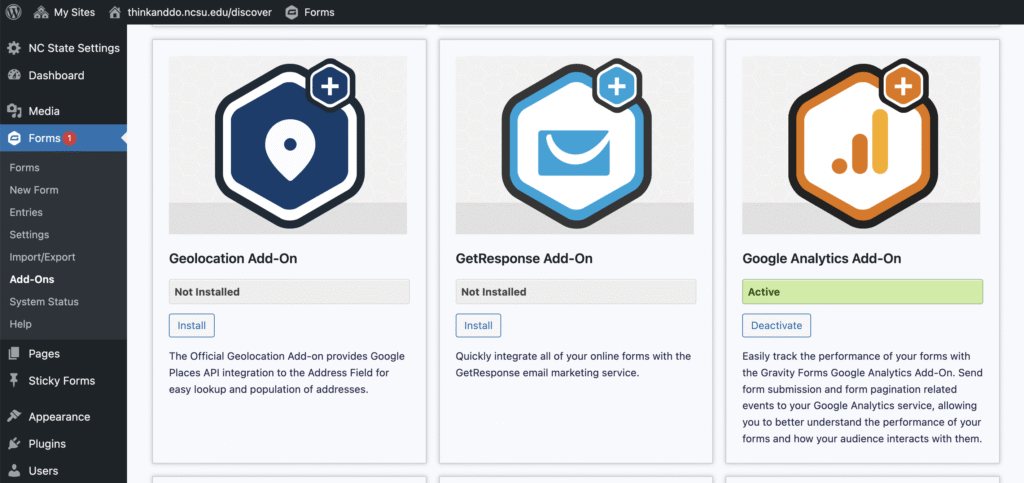
Next, navigate to Gravity Forms > Settings > Google Analytics and set up the Google Analytics connection. For most users, using the Google Measurement Protocol is recommended and requires the least additional setup and configuration. Follow the prompts to connect Gravity Forms to your GA4 property.
If you are managing your own analytics for your Landing Page Builder account and would like to use Google Tag Manager, please refer to the official documentation. This article from Analytics Mania is also a helpful resource.


Now, for each new form you create that you would like to measure in Google Analytics, you must create a “feed” within the form settings. If you skip this step on any form you create, you will not have any Google Analytics data for it.
Navigate to the settings for the form you would like to measure in GA4 and, under the Google Analytics settings, click “Add New” to create a feed.

Configure the Google Analytics feed for your form to your liking. Enter any parameters you would like to track in Google Analytics, but you must configure at least one in order for the feed to work. In the screenshot below, we have set the Parameter Name to “gforms_entry_id” and the Parameter Value to “Entry ID.”

If you are using a paginated form, some additional configuration is required to make that analytics data available in GA4. From the previous step, navigate to Form Settings and make sure to check “Enable pagination tracking” and set up any event parameter.

Click “Save Settings.” If you do a test form submission, you will now see gforms_submission — and gforms_pagination if you are using paginated forms — appear in your GA4 realtime overview.

But we’re not done yet! These Gravity Forms GA4 events will only be available in your GA4 realtime overview until you create custom definitions for them in your GA4 settings. In your GA4 admin dashboard, go to “custom definitions” and add custom dimensions for both gforms_submission and gforms_pagination.

This data will now be available in your GA4 reports.
Going forward, remember that you must set up a Google Analytics feed for each new Gravity Forms form you wish to track in GA4.